Click on the pictures to see enlarged versions of the images.

Saturday, February 19, 2011

Mary’s Girlhood


(Education of Mary by Anne, Her Mother,
from a 14th-century altar front with scenes
of the life of Mary)


(Saint Anne Teaches the Child Mary to
Read
, from the breviary of John the
Fearless, Duke of Burgundy, 1371-1419,
kept in the British Library; note the stylus
Mary is using to follow the words in the text)


(Education of the Girl Mary by Georges de la Tour, 1593-1652,
French painter)

“In every literate society, learning to read is something of an initiation, a ritualized passage out of a state of dependency and rudimentary communication. The child learning to read is admitted into the communal memory by way of books, and thereby becomes acquainted with a common past which he or she renews, to a great or lesser degree, in every reading.” ~ Alberto Manguel, from his book A History of Reading

Beginning in medieval times, images of Anne’s teaching her daughter Mary, the future mother of Christ, to read was a popular theme of stained glass windows and altar pieces in churches, of paintings, and of illuminations on the pages of books of hours and breviaries.

from MARY’S GIRLHOOD

Gone is a great while, and she
Dwelt young in Nazareth of Galilee.
Unto God’s will she brought devout respect
Profound simplicity of intellect.
And supreme patience. From her mother’s knee
Faithful and hopeful; wise in charity;
Strong in grave peace; in pity circumspect.

~ Dante Gabriel Rossetti (1828-1882), English poet, painter, and illustrator

Friday, February 18, 2011

A Boy’s Head


(Photo by Vivian Maier, 1926-2009, American “street
photographer,” from a collection of tens of thousands
of photographs she took on the streets of mid-century
Chicago; her work was discovered when a real estate
agent found the negatives in 2007 at an auction of boxes
abandoned in storage lockers)

“Recall that the imagination is a natural faculty in man. Some people make the mistake of fostering it, but it is often so powerful on its own that it will assert itself if we simply allow people to live what used to pass for an ordinary life. If you are breathing hard from the airborne soot of a city, all it may take for your lungs to clear again is to spend a week in the country. And all it might take for the imagination to breathe again is some time in solitude and silence.” ~ Anthony Esolen, from his book Ten Ways to Destroy the Imagination of Your Child

A BOY’S HEAD

In it there is a space-ship
and a project
for doing away with piano lessons.

And there is
Noah’s ark,
which shall be first.

And there is
an entirely new bird,
an entirely new hare,
an entirely new bumble-bee.

There is a river
that flows upwards.

There is a multiplication table.

There is anti-matter.

And it just cannot be trimmed.

I believe
that only what cannot be trimmed
is a head.

There is much promise
in the circumstance
that so many people have heads.

~ Miroslav Holub (1923-1998), Czech poet

Thursday, February 17, 2011

Piano


(The Piano Lesson by Henri Matisse, 1869-1954,
French printmaker, painter, and sculptor)

Both the art and the poem today recreate a memory of a young boy at a piano — but with a different tempo and perspective.

Matisse’s painting is of his son Pierre’s practicing the piano to the beat of a metronome. It records the fleeting moment as the triangle of a shadow flashes across his face. This image anticipates a memory for the boy in the future.

Lawrence’s poem is of a scene from his boyhood of sitting under the piano listening to his mother’s playing and singing. This memory is made up of more than a brief moment; it blends together repeated Sunday evenings by the piano.


PIANO

Softly, in the dusk, a woman is singing to me;
Taking me back down the vista of years, till I see
A child sitting under the piano, in the boom of the tingling strings
And pressing the small, poised feet of a mother who smiles as she sings.

In spite of myself, the insidious mastery of song
Betrays me back, till the heart of me weeps to belong
To the old Sunday evenings at home, with winter outside
And hymns in the cozy parlor, the tinkling piano our guide.

So now it is vain for the singer to burst into clamor
With the great black piano appassionato. The glamour
Of childish days is upon me, my manhood is cast
Down in the flood of remembrance, I weep like a child for the past.

~ D. H. Lawrence (1885-1930), English novelist, poet, and literary critic

Wednesday, February 16, 2011

The Land of Counterpane

Robert Louis Stevenson, the creator of such characters as Dr. Jeckyll and Mr. Hyde and Long John Silver, wrote one of the most charming collections of poetry for children, A Child’s Garden of Verse. The book is dedicated to his nurse or nanny, Alice “Cunny” Cunningham:

For the long nights you lay awake
And watched for my unworthy sake:
For your most comfortable hand
That led me through the uneven land:
For all the story-books you read,
For all the pains you comforted,
For all you pitied, all you bore,
In sad and happy days of yore: —


(The Land of Counterpane by Jessie
Willcox Smith, 1863-1935, American
illustrator)

Today’s poem recalls the time Stevenson spent in bed as a sickly child.

THE LAND OF COUNTERPANE

When I was sick and lay a-bed,
I had two pillows at my head,
And all my toys beside me lay
To keep me happy all the day.

And sometimes for an hour or so
I watched my leaden soldiers go,
With different uniforms and drills,
Among the bed-clothes, through the hills;

And sometimes sent my ships in fleets
All up and down among the sheets;
Or brought my trees and houses out,
And planted cities all about.

I was the giant great and still
That sits upon the pillow-hill,
And sees before him, dale and plain,
The pleasant land of counterpane.

~ Robert Louis Stevenson (1850-1894), Scottish poet, novelist, and travel writer

Tuesday, February 15, 2011

Saying Goodbye to Very Young Children


(The Little Parisian by Willy Ronis, 1910-2009,
French photographer)

As a youth, Willy Ronis studied music and composition. He wanted to become a violinist. Those plans had to change when his father became ill and he had to take charge of his father’s photographic studio. But his love of classical music stayed with him and infused his photography with “the taste I have for composition, particularly counterpoint. Many of my photographs are taken from above, either looking down or up, three planes in one image, like three different melodies in a fugue which work together to give the piece structure and harmony.”

SAYING GOODBYE TO VERY YOUNG CHILDREN

They will not be the same next time. The sayings
so cute, just slightly off, will be corrected.
Their eyes will be more skeptical, plugged in
the more securely to the worldly buzz
of television, alphabet, and street talk,
culture polluting their gazes’ pure blue.
It makes you see at last the value of
those boring aunts and neighbors (their smells
of summer sweat and cigarettes, their faces
like shapes of sky between shade-giving leaves)
who knew you from the start, when you were zero,
cooing their nothings before you could be bored
or knew a name, not even your own, or how
this world brave with hellos turns all goodbye.

~ John Updike (1932-2009), American poet, novelist, and critic

Monday, February 14, 2011

Valentine’s Day


(Boy and Girl on a Hillside by Winslow Homer, 1836-1910,
American artist)

This children’s ditty is a variation on the traditional sentiments of the day.

VALENTINE’S DAY

Roses are red,
Violets are blue,
Sugar is sweet,
And so are you.

Roses are red,
Cabbages are green,
If my face is funny,
Yours is a scream.

~ Anonymous

Sunday, February 13, 2011

Prayer for a New Mother


(Holy Family — Mary, Jesus, and Joseph,
from an illuminated manuscript of a Book
of Hours, or Devotions, created by an
anonymous Dutch artist, around 1440, for
Catherine of Cleves)

Sometimes an artist will surprise you. For example, Salvador Dali, the Spanish painter who seemed to relish breaking down cultural signposts into surreal pieces, also painted reverential images from the Bible, including the Last Supper and the Crucifixion.

Dorothy Parker — yes, that New Yorker who “perfected a light, humorous, cynical verse,” in the words of one critic — wrote several poems about Mary, the Mother of Christ, that would delight the reader with her observations about love and motherhood.


PRAYER FOR A NEW MOTHER

The things she knew, let her forget again —
The voices in the sky, the fear, the cold,
The gaping shepherds, and the queer old men
Piling their clumsy gifts of foreign gold.

Let her have laughter with her little one;
Teach her the endless, tuneless songs to sing,
Grant her her right to whisper to her son
The foolish names one dare not call a king.

Keep from her dreams the rumble of a crowd,
The smell of rough-cut wood, the trail of red,
The thick and chilly whiteness of the shroud
That wraps the strange new body of the dead.

Ah, let her go, kind Lord, where mothers go
And boast his pretty words and ways, and plan
The proud and happy years that they shall know
Together, when her son is grown a man.

~ Dorothy Parker (1893-1967), American writer of poetry and short stories

Saturday, February 12, 2011

The End


(Portrait of a Small Child by Wilhelm List, 1864-1918,
German painter)

“What I want to explain in the Introduction is this. We have been nearly three years writing this book. We began it when we were very young . . . and now we are six. So, of course, bits of it seem rather babyish to us, almost as if they had slipped out of some other book by mistake. On page whatever-it-is there is a thing which is simply three-ish, and when we read it to ourselves just now we said, ‘Well, well, well,’ and turned over rather quickly. So we want you to know that the name of the book doesn’t mean that this is us being six all the time, but that it is about as far as we’ve got at present, and we half think of stopping there.” ~ A. A. Milne, from the introduction to his book When We Are Six

THE END

When I was One,
I had just begun.

When I was Two,
I was nearly new.

When I was Three,
I was hardly Me.

When I was Four,
I was not much more.

When I was Five,
I was just alive.

But now I am Six, I’m as clever as clever.
So I think I’ll be six now for ever and ever.

~ A. A. Milne (1882-1956), English poet and writer and father of Christopher Robin

Friday, February 11, 2011

For a Sleepless Child


(Child with a Dove by Marc Chagall, 1887-1985,
Russian-French artist)

Many of Chagall’s paintings have a gentle, dream-like quality about them, like happy memories of childhood.

FOR A SLEEPLESS CHILD

If your room is ever too dark,
small one, look out through your window
up at the moon, that little bulb
left on for you in the sky’s black wall.
It will still be there come morning,
burning in a bright room of blue.

And if your room, restless one,
is much too still, listen to the clatter
of the freight, rattling past trestles
on the cool night breeze. Then follow
the moon to the side of the tracks,
where the train is a long, slow dream

you can jump on. An open car
is waiting for you — one step up —
you’re on! Now watch the dark towns, the lights
deep in the porches, and lie down
in the soft straw, and sleep till morning,
when the train chugs into station,

noisy with birds and wires overhead.

~ Peter Schmitt, American poet

Thursday, February 10, 2011

Nurse’s Song


(Prairie Children Building a Snow Fort by William
Kurelek, 1927-1977, Canadian artist and writer)

William Blake wrote two poems with identical titles and opening lines but with very opposite moods.

In the poem below, from
Songs of Innocence, the nurse or nanny is happy and cheerful and kind towards the children. In Blake’s other version, from Songs of Experience, she is not.

The differences between the two volumes reflect, Blake suggests, how the struggle between good and evil in life can transform innocence to experience.


NURSE’S SONG

When the voices of children are heard on the green,
And laughing is heard on the hill,
My heart is at rest within my breast,
And everything else is still.

“Then come home, my children, the sun is gone down,
And the dews of night arise;
Come, come leave off play, and let us away
Till the morning appears in the skies.”

“No, no, let us play, for it is yet day,
And we cannot go to sleep;
Besides, in the sky the little birds fly,
And the hills are all cover'd with sheep.”

“Well, well, go and play till the light fades away,
And then go home to bed.”
The little ones leaped, and shouted, and laughed
And all the hills echoed.

~ William Blake, 1757-1827, English poet, painter, engraver, and mystic visionary

Wednesday, February 9, 2011

Answer to a Child’s Question


(Child with an Orange by Vincent van Gogh, 1853-1890,
Dutch Post-Impressionist painter)

A wonderful question. And a sensible answer.

ANSWER TO A CHILD’S QUESTION

Do you ask what the birds say? The Sparrow, the Dove,
The Linnet, and Thrush say, “I love and I love!”
In the winter they’re silent — the wind is so strong;
What it says I don’t know, but it sings a loud song.
But green leaves, and blossoms, and sunny warm weather,
And singing, and loving — all come back together.
Then the Lark is so brimful of gladness and love,
The green fields below him, the blue sky above,
That he sings, and he sings, and for ever sings he —
“I love my Love, and my Love loves me.”

~ Samuel Taylor Coleridge (1772-1834), English Romantic poet

Tuesday, February 8, 2011

Mother’s Song


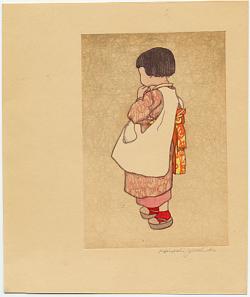
(Young Japanese Girl by Hiroshi Yoshida,
1876-1950, Japanese painter and woodblock
printmaker)

MOTHER’S SONG

If snow falls on the far field
where travelers
spend the night,
I ask you, cranes,
to warm my child in your wings.

~ Anonymous, Japanese

Monday, February 7, 2011

Evening Benediction


(The Cradle by Berthe Morisot, 1841-1895,
French Impressionist painter)

The story about brother and sister Hansel and Gretel is one of the many German folk tales collected by the linguists Wilhelm and Jacob Grimm in the first decades of the nineteenth century.

Years later, this Brothers Grimm fairy tale was transformed into an opera by Engelbert Humperdinck. It was first performed in 1893 under the baton of Richard Strauss, and remains popular, especially during the Christmas holiday.

The words below are sung by the two children when they become lost and scared in a dark forest.


EVENING BENEDICTION

When at night I go to sleep,
Fourteen angels watch do keep:
Two my head are guarding,
Two my feet are guiding,
Two are on my right hand,
Two are on my left hand,
Two who warmly cover,
Two who o’er me hover,
Two to whom ’tis given
To guide my steps to heaven.

~ Engelbert Humperdinck (1854-1921), German composer

Sunday, February 6, 2011

You’re


(Mother Holding Baby by Keith Haring, 1958-1990,
American artist, famous for his street art)

“A baby, however, sells itself and needs no advertising copy; few people can resist it. There is something about babyness that brings out the softness in people and makes them want to hug and protect this small thing that moves and dribbles and produces what we poetically call poopoo. Even that becomes precious, for the arrival of a baby coincides with the departure of our minds. My wife and I often summoned the grandparents of our first baby and proudly cried, ‘Look! Poopoo!’ A statement like this is the greatest single disproof of evolution I know.” ~ Bill Cosby, from his book Fatherhood

YOU’RE

Clownlike, happiest on your hands,
Feet to the stars, and moon-skulled,
Gilled like a fish. A common-sense
Thumbs-down on the dodo’s mode.
Wrapped up in yourself like a spool,
Trawling your dark, as owls do.
Mute as a turnip from the Fourth
Of July to All Fools’ Day,
O high-riser, my little loaf.

Vague as fog and looked for like mail.
Farther off than Australia.
Bent-backed Atlas, our traveled prawn.
Snug as a bud and at home
Like a sprat in a pickle jug.
A creel of eels, all ripples.
Jumpy as a Mexican bean.
Right, like a well-done sum.
A clean slate, with your own face on.

~ Sylvia Plath (1932-1963), American poet, and writer of novels and short stories

Saturday, February 5, 2011

Lullaby of the Iroquois


(Hoopa Indian Mother and Baby by Edward
Curtis, 1868-1952, American photographer)

Pauline Johnson (1861-1914) was a popular Canadian poet, writer, and entertainer. Her father was Mohawk-Canadian and her mother English. Pauline took on her great-grandfather’s name Tekahionwake, or “double life,” as she toured the country to perform her works on stage, wearing traditional Mohawk dress. She is best-known now for one of her poems, “The Song My Paddle Sings,” and a collection of short stories based on west-coast Squamish legends.

LULLABY OF THE IROQUOIS

Little brown baby-bird, lapped in your nest,
Wrapped in your nest,
Strapped in your nest,
Your straight little cradle-board rocks you to rest;
Its hands are your nest;
Its bands are your nest;
It swings from the down-bending branch of the oak;
You watch the camp flame, and the curling gray smoke;
But, oh, for your pretty black eyes sleep is best, —
Little brown baby of mine, go to rest.

Little brown baby-bird swinging to sleep,
Winging to sleep,
Singing to sleep,
Your wonder-black eyes that so wide open keep,
Shielding their sleep,
Unyielding to sleep,
The heron is homing, the plover is still,
The night-owl calls from his haunt on the hill,
Afar the fox barks, afar the stars peep, —
Little brown baby of mine, go to sleep.

~ Pauline Johnson

Friday, February 4, 2011

Minnie and Winnie


(The Cholmondeley Ladies, dated to 1600-1610, by an
unknown English painter)

The painting is of two young women sitting on a bed and holding, we may assume, their babies wrapped in red christening robes. The painting is named after Thomas Cholmondeley (pronounced Chumley), to whose collection this portrait originally belonged. The women may be his daughters or nieces, or sisters who married into the Cholmondeley family.

MINNIE AND WINNIE

Minnie and Winnie
Slept in a shell.
Sleep, little ladies!
And they slept well.

Pink was the shell within,
Silver without;
Sounds of the great sea
Wandered about.

Sleep, little ladies,
Wake not soon!
Echo on echo
Dies to the moon.

Two bright stars
Peeped into the shell.
“What are they dreaming of?
Who can tell?”

Started a green linnet
Out of the croft;
Wake, little ladies,
The sun is aloft!

~ Alfred, Lord Tennyson (1809-1892), English poet

Thursday, February 3, 2011

Crying, My Little One


(Mother and Child by Diego Rivera, 1886-1957,
Mexican painter and muralist)

“The maternal instinct . . . is a Gift-love, but one that needs to give; therefore needs to be needed. But the proper aim of giving is to put the recipient in a state where he no longer needs our gift. We feed children in order that they may soon be able to feed themselves; we teach them in order that they may soon not need our teaching. Thus a heavy task is laid upon this Gift-love. It must work towards its own abdication. We must aim at making ourselves superfluous. The hour when we can say ‘They need me no longer’ should be our reward. But the instinct, simply in its own nature, has no power to fulfill this law. The instinct desires the good of its object, but not simply; only the good it can itself give. A much higher love — a love which desires the good of the object as such, from whatever source that good comes — must step in and help or tame the instinct before it can make the abdication”. ~ C. S. Lewis, from his book The Four Loves

CRYING, MY LITTLE ONE

Crying, my little one, footsore and weary?
Fall asleep, pretty one, warm on my shoulder:
I must tramp on through the winter night dreary,
While the snow falls on me colder and colder.

You are my one, and I have not another;
Sleep soft, my darling, my trouble and treasure;
Sleep warm and soft in the arms of your mother,
Dreaming of pretty things, dreaming of pleasure.

~ Christina Rossetti (1830-1894), English poet

Wednesday, February 2, 2011

Freight


(Mother and Baby by Ruth Orkin, 1921-1985,
American photographer)

Life is often compared to a journey.

The Roman poet Lucretius (99?-55? B.C.) writes of the new-born babe as “a sailor cast up by the sea, / Lying naked on the shore, unable to speak, / Helpless, when it comes to the light of day.”

And René Graziani’s wonderful collection of poems on birth and birthdays is entitled
The Naked Astronaut, “that nine-month traveler into time, attached by the umbilicus to its mother and her life-support system.”

FREIGHT

I am the ship in which you sail,
little dancing bones,
your passage between the dream
and the waking dream,
your sieve, your pea-green boat.
I’ll pay whatever toll your ferry needs.
And you, whose history’s already charted
in a rope of cells, be tender to
those other unnamed vessels
who will surprise you one day,
tug-tugging, irresistible,
and float you out beyond your depth,
where you’ll look down, puzzled, amazed.

~ Maura Dooley, born 1957, English poet

Tuesday, February 1, 2011

The Dream Keeper


(The Problem We All Live With, 1963, by Norman Rockwell,
1894-1978, American artist and illustrator)

This month we will drop in on childhood.

It was 8:40 in the morning of November 14, 1960, when little Ruby Bridges tried to go to class at the William Franz School in New Orleans. She had to walk through a crowd of angry housewives and teenagers who came every morning to protest the integration of the school.

In his book
Travels with Charley, John Steinbeck wrote down what he saw that morning as he was driving through the city.

“The show opened on time. Sound the sirens. Motorcycle cops. Then two big black cars filled with big men in blond felt hats pulled up in front of the school. The crowd seemed to hold its breath. Four big marshals got out of each car and from somewhere in the automobiles they extracted the littlest Negro girl you ever saw, dressed in shining starchy white, with new white shoes on feet so little they were almost round. Her face and little legs were very black against the white.

“The big marshals stood her on the curb and a jangle of jeering shrieks went up from behind the barricades. The little girl did not look at the howling crowd, but from the side, the whites of her eyes showed like those of a frightened fawn. The men turned her around like a doll, and then the strange procession moved up the broad walk toward the school, and the child was even more a mite because the men were so big. Then the girl made a curious hop, and I think I know what it was. I think in her whole life she had not gone ten steps without skipping, but now in the middle of her first step, the weight bore her down and her little round feet took measured, reluctant steps between the tall guards. Slowly they climbed the steps and entered the school.”


THE DREAM KEEPER

Bring me all of your dreams,
You dreamers.
Bring me all your
Heart melodies
That I may wrap them
In a blue cloud-cloth
Away from the too-rough fingers
Of the world.

~ Langston Hughes (1902-1967), American novelist, playwright, and poet, active in the Harlem Renaissance

Monday, January 31, 2011

Winter Love


(Awaiting the Train, Bertherville, Quebec by Kathleen
Morris, 1893-1986, Canadian painter)

We now come to the end of January. This month, we’ve been listening in the snow, taking heed of the silence.

Our final poem on this theme proposes that silence signifies more than an absence of sound.


WINTER LOVE

I would like to decorate this silence,
but my house grows only cleaner
and more plain. The glass chimes I hung
over the register ring a little
when the heat goes on.
I waited too long to drink my tea.
It was not hot. It was only warm.

~ Linda Gregg, born 1942, American poet

Sunday, January 30, 2011

Snow in the Suburbs


(Pine Tree and Red House by Lawren Harris, 1885-1970,
Canadian artist)

Take a walk in your neighborhood and you’ll come upon a pantomime.

SNOW IN THE SUBURBS

Every branch big with it,
Bent every twig with it;
Every fork like a white web-foot;
Every street and pavement mute:
Some flakes have lost their way, and grope back upward, when
Meeting those meandering down they turn and descend again.
The palings are glued together like a wall,
And there is no waft of wind with the fleecy fall.

A sparrow enters the tree,
Whereon immediately
A snow-lump thrice his own slight size
Descends on him and showers his head and eyes,
And overturns him,
And near inurns* him,
And lights on a nether twig, when its brush
Starts off a volley of other lodging lumps with a rush.

The steps are a blanched slope,
Up which, with feeble hope,
A black cat comes, wide-eyed and thin;
And we take him in.

~ Thomas Hardy (1840-1928), English novelist and poet

* inurn – to put in an urn, to entomb or bury

Saturday, January 29, 2011

Snow


(Village in the Snow by George Callaghan, Irish artist)

This poem is by Janet Frame (1924-2004), a novelist and poet from New Zealand. She spent years in insane asylums for the treatment of schizophrenia. In her late twenties, she was even scheduled for a lobotomy. Only the announcement that she had won a literary prize prevented that operation.

Janet Frame’s startlingly imaginative works bring up questions that perhaps we should leave for the psychiatrist or the philosopher. Mental illness can distort one’s sense of reality. Could we then say that this is one source of her remarkably original images or metaphors? Or, is it more accurate to say that creativity, like character or personality, is largely independent of an illness?

You can learn more about Janet Frame from a sensitive film of her life,
An Angel at My Table. It is based on her autobiography and was directed by Jane Campion, another artist from New Zealand.

SNOW

A crime so frequent, so huge
of fraud and camouflage
would make it seem almost natural
the hurt world lying forever
locked in plaster
with some remembering the green
underneath,
others never forgetting the
fracture.

~ Janet Frame

Friday, January 28, 2011

The Snow Man


(A Möbius Strip)

This popular and well-known poem has been a puzzle to many.

For the pessimists, it seems to describe the prospect that there is really nothing to see or to be. We just are.

Others reject this nihilism and insist that even nothingness is still a presence and should therefore not be dismissed.

A clue to the poem’s meaning may lie in its fascinating yet difficult construction, bringing to mind the unending circularity of the möbius strip. The poem is just one sentence, divided into sections that go around and around each other, right back to the beginning until the end, and back again.

The poet sticks to the adage: show, not tell. The form tells the story. The reader begins with the past, comes to the present, which includes the past, a past that is nothingness because it may be gone but still forms part of our present, and then begins it all over again. In short, nothing is to be lost; all has meaning.

Or, then again, perhaps it’s just about snow swirling all around us, seemingly without direction.


THE SNOW MAN

One must have a mind of winter
To regard the frost and the boughs
Of the pine-trees crusted with snow;

And have been cold a long time
To behold the junipers shagged with ice,
The spruces rough in the distant glitter

Of the January sun; and not to think
Of any misery in the sound of the wind,
In the sound of a few leaves,

Which is the sound of the land
Full of the same wind
That is blowing in the same bare place

For the listener, who listens in the snow,
and, nothing himself, beholds
Nothing that is not there and the nothing that is.

~ Wallace Stevens (1879-1955), American poet and insurance company executive

Thursday, January 27, 2011

The Times Are Nightfall


(Red, Orange, Tan and Purple, 1954 by Mark
Rothko, 1903-1970, American painter)

The poet begins with winter as a metaphor for the bleak and dark and cold of despair, but then reminds us of the powerful choice within us, to use our free will.

THE TIMES ARE NIGHTFALL

The times are nightfall, look, their light grows less;
The times are winter, watch, a world undone:
They waste, they wither worse; they as they run
Or bring more or more blazon man’s distress.
And I not help. Nor word now of success:
All is from wreck, here, there, to rescue one —
Work which to see scarce so much as begun
Makes welcome death, does dear forgetfulness.

Or what is else? There is your world within.
There rid the dragons, root out there the sin.
Your will is law in that small commonweal…

~ Gerard Manley Hopkins, S.J. (1844-1899), British poet whose work has had a profound influence on modern poetry

Wednesday, January 26, 2011

Absences


(Winter Woodcut by Fritz Bleyl, 1880-1966,
German artist)

Sometimes all you need is the gentle sound of snow falling to trigger some fleeting memories.

ABSENCES

It’s snowing this afternoon and there are no flowers.
There is only this sound of falling, quiet and remote,
Like the memory of scales descending the white keys
Of a childhood piano — outside the window, palms!
And the heavy head of the cereus*, inclining,
Soon to let down its white or yellow-white.

Now, only these poor snow-flowers in a heap,
Like the memory of a white dress cast down . . .
So much has fallen.

And I, who have listened for a step
All afternoon, hear it now, but already falling away,
Already in memory. And the terrible scales descending
On the silent piano; the snow; and the absent flowers abounding.

~ Donald Justice (1925-2004), American poet

* cereus – a cactus, in this case, the lunar or night-blooming cereus, with its large blossom that appears once a year for one or two days before it falls off

Tuesday, January 25, 2011

Why Is the Color of Snow?


(Reflections in the Creek by A. Y. Jackson, 1882-1974,
Canadian painter)

Some questions are difficult to answer, even by a poet.

WHY IS THE COLOR OF THE SNOW?

Let’s ask a poet with no way of knowing.
Someone who can give us an answer,
another duplicity to help double the world.

What kind of poetry is all question, anyway?
Each question leads to an iceburn,
a snownova, a single bed spinning in space.

Poet, Decide! I am lonely with questions.
What is snow? What isn’t?
Do you see how it is for me.

Melt yourself to make yourself more clear
for the next observer.
I could barely see you anyway.

A blizzard I understand better,
the secrets of many revealed as one,
becoming another on my only head.

It’s true that snow takes on gold from sunset
and red from rearlights. But that's occasional.
What is constant is white,

or is that only sight, a reflection of eyewhites
and light? Because snow reflects only itself,
self upon self upon self,

is a blanket used for smothering, for sleeping.
For not seeing the naked, flawed body.
Concealing it from the lover curious, ever curious!

Who won’t stop looking.
White for privacy.
Millions of privacies to bless us with snow.

Don’t we melt it?
Aren't we human dark with sugar hot to melt it?
Anyway, the question —

if a dream is a construction then what
is not a construction? If a bank of snow
is an obstruction, then what is not a bank of snow?

A winter vault of valuable crystals
convertible for use only by a zen
sun laughing at us.

Oh Materialists! Thinking matter matters.
If we dream of snow, of banks and blankets
to keep our treasure safe forever,

what world is made, that made us that we keep
making and making to replace the dreaming at last.
To stop the terrible dreaming.

~ Brenda Shaughnessy, born 1970, American poet

Monday, January 24, 2011

The Partial Explanation


(Late Afternoon, New York, Winter by Childe
Hassam, 1859-1935, American painter)

The source of the word eavesdrop is the Old English yfesdrype, from eave (brink or brim) and drip. Thus, to eavesdrop is to stand on the ground under the eaves or at walls or windows to listen to what is going on inside.

THE PARTIAL EXPLANATION

Seems like a long time
Since the waiter took my order.
Grimy little luncheonette,
The snow falling outside.

Seems like it has grown darker
Since I last heard the kitchen door
Behind my back
Since I last noticed
Anyone pass on the street.

A glass of ice-water
Keeps me company
At this table I chose myself
Upon entering.

And a longing,
Incredible longing
To eavesdrop
On the conversation
Of cooks.

~ Charles Simic, born 1938 in Yugoslavia, American poet and translator

Sunday, January 23, 2011

Hunters in the Snow


(Hunters in the Snow, 1565, by Peter Bruegel the Elder,
1529?-1569, Dutch landscape painter)

In October, we looked at different examples of ekphrasis, or literary commentary about a work of art. (Scroll down to that month’s poems in the “blog archives” in the column to the right.)

The first verse below is one of ten poems that William Carlos Williams wrote about paintings by Bruegel the Elder.


THE HUNTERS IN THE SNOW

The over-all picture is winter
icy mountains
in the background the return

from the hunt it is toward evening
from the left
sturdy hunters lead in

their pack the inn-sign
hanging from a
broken hinge is a stag a crucifix

between his antlers the cold
inn yard is
deserted but for a huge bonfire

that flares wind-driven tended by
women who cluster
about it to the right beyond

the hill is a pattern of skaters
Brueghel the painter
concerned with it all has chosen

a winter-struck bush for his
foreground to
complete the picture

~ William Carlos Williams (1883-1963), American poet and practicing physician

John Berryman’s poem about the same painting adds a more fateful scenario, in the future, viewed retrospectively.

WINTER LANDSCAPE

The three men coming down the winter hill
In brown, with tall poles and a pack of hounds
At heel, through the arrangement of the trees,
Past the five figures at the burning straw,
Returning cold and silent to their town,
Returning to the drifted snow, the rink
Lively with children, to the older men,
The long companions they can never reach,
The blue light, men with ladders, by the church
The sledge and shadow in the twilit street,

Are not aware that in the sandy time
To come, the evil waste of history
Outstretched, they will be seen upon the brow
Of that same hill: when all their company
Will have been irrecoverably lost,

These men, this particular three in brown
Witnessed by birds will keep the scene and say
By their configuration with the trees,
The small bridge, the red houses and the fire,
What place, what time, what morning occasion

Sent them into the wood, a pack of hounds
At heel and the tall poles upon their shoulders,
Thence to return as now we see them and
Ankle-deep in snow down the winter hill
Descend, while three birds watch and the fourth flies.

~ John Berryman (1917-1972), American poet

Saturday, January 22, 2011

The Breathing


(The Lynx by Christopher Pratt, born 1935, a Canadian
painter living in the province of Newfoundland)

Christopher Pratt is my favorite Canadian painter.

Some critics have dismissed his art as mere “realism,” cold and objective realism. But I think that one Toronto art curator had it right when he wrote: “Because Pratt paints things people recognize, they make that mistake. Nothing could be more misleading. He’s a metaphysical painter, concerned with defining qualities of experience rather than portraying specific objects or events. His work is as abstract as Mondrian.”


THE BREATHING

An absolute
patience.
Trees stand
up to their knees in
fog. The fog
slowly flows
uphill.
White
cobwebs, the grass
leaning where deer
have looked for apples.
The woods
from brook to where
the top of the hill looks
over the fog, send up
not one bird.
So absolute, it is
no other than
happiness itself, a breathing
too quiet to hear.

~ Denise Levertov (1923-1997), English-born American poet

Friday, January 21, 2011

January


(January by Grant Wood, 1891-1942, American painter)

Mary Oliver is part of the Romantic set, sitting around the table with poets like Wordsworth, Keats, and Shelley. Like them, she finds the source of happiness in Nature, and she is inclined to make use of the pathetic fallacy, attaching human qualities and emotions to flora and fauna and inanimate objects.

Unlike them, however, she does not write in the sonnet form, preferring instead a series of stanzas with three or four short lines each. Also unlike them, she sometimes hints at a mysterious something. In this poem, for example, just what is this bird? And exactly how large is it?


WHITE-EYES

In winter
all the singing is in
the tops of the trees
where the wind-bird

with its white eyes
shoves and pushes
among the branches.
Like any of us

he wants to go to sleep,
but he’s restless —
he has an idea,
and slowly it unfolds

from under his beating wings
as long as he stays awake.
But his big, round music, after all,
is too breathy to last.

So, it’s over.
In the pine-crown
he makes his nest,
he’s done all he can.

I don’t know the name of this bird,
I only imagine his glittering beak
tucked in a white wing
while the clouds —

which he has summoned
from the north —
which he has taught
to be mild, and silent —

thicken, and begin to fall
into the world below
like stars, or the feathers
of some unimaginable bird

that loves us,
that is asleep now, and silent —
that has turned itself
into snow.

~ Mary Oliver, born 1935, American poet

Thursday, January 20, 2011

A Winter Twilight


(Abstract Treescape by Fritz Brandtner, 1896-1969,
Canadian artist)

Listen for the hushed sounds that join the silence.

A WINTER TWILIGHT

A silence slipping around like death,
Yet chased by a whisper, a sigh,
a breath; One group of trees, lean,
naked and cold,
Inking their cress ’gainst a
sky green-gold;

One path that knows where the
corn flowers were;
Lonely, apart, unyielding, one fir;
And over it softly leaning down,
One star that I loved ere the
fields went brown.

~ Angelina Weld Grimké (1880-1958), American playwright and poet, active in the Harlem Renaissance

Wednesday, January 19, 2011

Lines for Winter


(Bear Tracks, woodcut by Mary Okheena, born 1957,
Canadian Inuit artist)

Inuit is now the preferred name for the indigenous peoples of northern Canada and of Greenland. It replaces the older name of Eskimo, which is still favored in Alaska.

LINES FOR WINTER

Tell yourself
as it gets cold and gray falls from the air
that you will go on
walking, hearing
the same tune no matter where
you find yourself —
inside the dome of dark
or under the cracking white
of the moon’s gaze in a valley of snow.
Tonight as it gets cold
tell yourself
what you know which is nothing
but the tune your bones play
as you keep going. And you will be able
for once to lie down under the small fire
of winter stars.
And if it happens that you cannot
go on or turn back
and you find yourself
where you will be at the end,
tell yourself
in that final flowing of cold through your limbs
that you love what you are.

~ Mark Strand, born 1934, American poet and translator

Tuesday, January 18, 2011

Jack Frost


(Holiday Snowflakes, stamps based on photographs by
Kenneth Libbrecht, professor of physics at Caltech)

There they are, the pages of an illustrated storybook printed on the window panes.

JACK FROST

The door was shut, as doors should be,
Before you went to bed last night;
Yet Jack Frost has got in, you see,
And left your window silver white.

He must have waited till you slept;
And not a single word he spoke,
But penciled o’er the panes and crept
Away again before you woke.

And now you cannot see the hills
Nor fields that stretch beyond the lane;
But there are fairer things than these
His fingers traced on every pane.

Rocks and castles towering high;
Hills and dales, and streams and fields;
And knights in armor riding by,
With nodding plumes and shining shields.

And here are little boats, and there
Big ships with sails spread to the breeze;
And yonder, palm trees waving fair
On islands set in silver seas,

And butterflies with gauzy wings;
And herds of cows and flocks of sheep;
And fruit and flowers and all the things
You see when you are sound asleep.

For, creeping softly underneath
The door when all the lights are out,
Jack Frost takes every breath you breathe,
And knows the things you think about.

He paints them on the window-pane
In fairy lines with frozen steam;
And when you wake you see again
The lovely things you saw in dream.

~ Gabriel Setoun (1861-1930), pseudonym of Thomas Hepburn, Scottish poet and novelist

Monday, January 17, 2011

Boy at the Window


(A gathering of snowmen with attached good luck wishes
at the annual Sapporo Snow Festival in Japan)

The simple title of this poem gives no hint of the drama about to be revealed.

BOY AT THE WINDOW

Seeing the snowman standing all alone
In dusk and cold is more than he can bear.
The small boy weeps to hear the wind prepare
A night of gnashings and enormous moan.
His tearful sight can hardly reach to where
The pale-faced figure with bitumen eyes
Returns him such a God-forsaken stare
As outcast Adam gave to paradise.

The man of snow is, nonetheless, content,
Having no wish to go inside and die.
Still, he is moved to see the youngster cry.
Though frozen water is his element,
He melts enough to drop from one soft eye
A trickle of the purest rain, a tear
For the child at the bright pane surrounded by
Such warmth, such light, such love, and so much fear.

~ Richard Wilbur, born 1921, American poet and translator

Sunday, January 16, 2011

Winter Solitude - A Haiku


(Trees in Winter, woodcut by Karl Schmidt-Rottluff,
1884-1976, German Expressionist artist)

Winter solitude —
in a world of one color
the sound of wind.

~ Matsuo Bashō (1644-1694), Japanese poet

Saturday, January 15, 2011

A Guest


(Oxen Team, Winter by Maud Lewis,
1903-1970, Canadian painter)

Maud Lewis was a folk artist much like Grandma Moses (for her work, see the “index of the authors and artists” in the column to the right). She was a true amateur, a painter with a great joy in her art but no formal training and no connection to the artistic community. She and her husband, an itinerant fish peddler, were quite poor. Their home was a tiny house, barely 13 by 13 feet, in rural Nova Scotia, with a sleeping loft upstairs and no modern amenities like electricity. But it was very colorful, for she painted almost every surface, inside and out, with pictures of birds and flowers, including the door and windows and stove and walls.

She was born with many physical handicaps. “When I first met Maud Lewis, I was a child. When I first met Maud Lewis, I thought she was a witch. Maud was then a little old woman, as little as I was and her hands were twisted and her back was bent like a hunchback’s. Her shoulders were tilted and her bright eyes glittered,” wrote a neighbor of hers years later.

She was a prolific painter of the life outdoors she saw from her perch by a window. Maud Lewis was also popular, as were her paintings.


A GUEST

My woods belong to woodcock and to deer;
For them, it is an accident I am here.

If, for the plump raccoon, I represent
An ash can that was surely heaven-sent,

The bright-eyed mask, the clever little paws
Obey not mine, but someone else’s laws.

The young buck takes me in with a long glance
That says that I, not he, am here by chance.

And they all go their ways, as I must do,
Up through the green and down again to snow,

No one of us responsible or near,
But each himself and in the singular.

When we do meet, I am the one to stare
As if an angel had me by the hair,

As I am flooded by some ancient bliss
Before all I possess and can’t possess.

So when a stranger knocks hard at the door,
He cannot know what I am startled for —

To see before me an unfurry face,
A creature like myself in this wild place.

Our wilderness gets wilder every day
And we intend to keep the tamed at bay.

~ May Sarton (1912-1995), American poet, and writer of novels and memoirs

Friday, January 14, 2011

A Winter's Tale


(Winter Landscape with Ice Skaters, circa 1608, by
Hendrick Avercamp, 1585-1634, Dutch painter)

Every poem benefits from being read out loud, the melodious poems of Dylan Thomas especially.

from A WINTER’S TALE

It is a winter’s tale
That the snow blind twilight ferries over the lakes
And floating fields from the farm in the cup of the vales,
Gliding windless through the hand folded flakes,
The pale breath of cattle at the stealthy sail,

And the stars falling cold,
And the smell of hay in the snow, and the far owl
Warning among the folds, and the frozen hold
Flocked with the sheep white smoke of the farm house cowl
In the river wended vales where the tale was told.

~ Dylan Thomas (1914-1953), the great Welsh poet and writer

Thursday, January 13, 2011

Winter Twilight


(Vertical by Ben Nicholson, 1894-1982, American painter)

Winter has its own illusions.

WINTER TWILIGHT

On a clear winter’s evening
The crescent moon

And the round squirrels’ nest
In the bare oak

Are equal planets.

~ Anne Porter, born 1911, American poet

Wednesday, January 12, 2011

Winter Night


(The Summer Gardens in Winter, St. Petersburg, woodcut
by Anna Ostroumova-Lebedeva, 1871-1955, Russian artist)

“As they drove through Kamerger Street Yura [Zhivago] noticed that a candle had melted a patch in the icy crust on one of the windows. The light seemed to look into the street almost consciously, as if it were watching the passing carriages and waiting for someone.

“‘A candle burned on the table, a candle burned . . . ,’ he whispered to himself — the beginning of something confused, formless; he hoped that it would take shape of itself.”


WINTER NIGHT

It snowed and snowed, the whole world over,
Snow swept the world from end to end.
A candle burned on the table;
A candle burned.

As during summer, midges swarm
To beat their wings against a flame.
Out in the yard the snowflakes swarmed
To beat against the window pane.

The blizzard sculptured on the glass
Designs of arrows and of whorls.
A candle burned on the table;
A candle burned.

Distorted shadows fell
Upon the lighted ceiling:
Shadows of crossed arms, of crossed legs —
Of crossed destiny.

Two tiny shoes fell to the floor
And thudded.
A candle on a nightstand shed wax tears
Upon a dress.

All things vanished within
The snowy murk-white, hoary.
A candle burned on the table;
A candle burned.

A corner draft fluttered the flame
And the white fever of temptation
Upswept its angel wings that cast
A cruciform shadow.

It snowed hard throughout the month
Of February, and almost constantly
A candle burned on the table;
A candle burned.

~ Boris Pasternak (1890-1960), Russian poet and novelist; the above prose and poem are from his novel Doctor Zhivago

Tuesday, January 11, 2011

Winter: Woman Looking from the Window at a Spruce Tree


(Winter Morning by Tom Thomson, 1877-1917, Canadian
painter)

“And the sunlight clasps the earth . . .” ~ Percy Bysshe Shelley (1792-1822), English Romantic poet

WINTER: WOMAN LOOKING FROM THE WINDOW AT A SPRUCE TREE

The sunlight catches in the heart
as if to steer a deeper self to memory
of a time gone, another life of
knowing the self as sunlight.
Not a small shy animal,
not a mystic saint or an
uncounted peasant hoeing corn,
but sunlight, playing alone in winter,
along a branch, moving lightly,
settling lightly on crystallized snow
held gently there, not especially warm,
but light, being right, and not thinking.
The earth was younger then,
in the deep green shine of spruce.

Though not still, self was silent then
and is that now, ineffably held.

~ Maryann Whalen, from Wild Songs: Poems of the Natural World

Monday, January 10, 2011

Pine Tree Tops


(Pine Trees, ink-on-paper screen by Hasegawa Tohaku,
1539-1610, Japanese artist)

This luminous example of an ink painting is a designated National Treasure of Japan. It is one of a pair of six-fold screens, each approximately 5 by 11 feet in size. As you walk through the thick mist, the description provided by the Tokyo National Museum tells us, black shadows appear and you are “surrounded by pine trees and can just detect the tops of mountains. The quiet scene, a momentary experience captured for eternity, evokes the rustic and refined realm” of wabi or elegant simplicity.

PINE TREE TOPS

in the blue night
frost haze, the sky glows
with the moon
pine tree tops
bend snow-blue, fade
into sky, frost, starlight.
the creak of boots.
rabbit tracks, deer tracks,
what do we know.

~ Gary Snyder, born 1930, American poet

Sunday, January 9, 2011

Snow Day


(Balsam Avenue, Toronto, After a Heavy Snowfall by
William Kurelek, 1927-1977, Canadian artist and writer)

I have a wonderful memory of sliding down a snowdrift from a second-storey window during one of the great blizzards of Winnipeg.

SNOW DAY

Today we woke up to a revolution of snow,
its white flag waving over everything,
the landscape vanished,
not a single mouse to punctuate the blankness,
and beyond these windows

the government buildings smothered,
schools and libraries buried, the post office lost
under the noiseless drift,
the paths of trains softly blocked,
the world fallen under this falling.

In a while, I will put on some boots
and step out like someone walking in water,
and the dog will porpoise through the drifts,
and I will shake a laden branch
sending a cold shower down on us both.

But for now I am a willing prisoner in this house,
a sympathizer with the anarchic cause of snow.
I will make a pot of tea
and listen to the plastic radio on the counter,
as glad as anyone to hear the news

that the Kiddie Corner School is closed,
the Ding-Dong School, closed.
the All Aboard Children’s School, closed,
the Hi-Ho Nursery School, closed,
along with — some will be delighted to hear —

the Toadstool School, the Little School,
Little Sparrows Nursery School,
Little Stars Pre-School, Peas-and-Carrots Day School,
the Tom Thumb Child Center, all closed,
and — clap your hands — the Peanuts Play School.

So this is where the children hide all day,
These are the nests where they letter and draw,
where they put on their bright miniature jackets,
all darting and climbing and sliding,
all but the few girls whispering by the fence.

And now I am listening hard
in the grandiose silence of the snow,
trying to hear what those three girls are plotting,
what riot is afoot,
which small queen is about to be brought down.

~ Billy Collins, born 1941, American poet

Saturday, January 8, 2011

the summer chair


(Winter in Maine by John Haapanen, 1891-1968, American
painter)

As we listen in the snow, a haiku.

the summer chair
rocking by itself
in the blizzard

~ Jack Kerouac (1922-1969), American of French-Canadian descent, a poet and novelist who wrote in both French and English and was one of the original members of the Beat Generation

Friday, January 7, 2011

The Fourth Wise Man


(Travels of the Three Kings by Salvador Dali, 1904-1989,
Spanish Surrealist painter)

“Three Kings came riding from far away, / Melchior and Gaspar and Baltasar.” ~ Henry Wadsworth Longfellow

THE FOURTH WISE MAN

The fourth wise man
disliked travel. If
you walk, there’s the
gravel. If you ride,
there’s the camel’s attitude.
He far preferred
to be inside in solitude
to contemplate the star
that had been getting
so much larger
and more prolate* lately —
stretching vertically
(like the souls of martyrs)
toward the poles
(or like the yawns of babies).

~ Kay Ryan, born 1945, American poet

* prolate - in geometry: having a polar diameter which is longer than the equatorial diameter

Thursday, January 6, 2011

The Gift


(Adoration of the Magi by Rembrandt van Rijn, 1606-1669,
Dutch painter, printmaker, and draughtsman)

Today is the feast of Epiphany.

“The star they had seen in the East went before them, until it came and stood over the place where the child was. And when they saw the star they rejoiced exceedingly. And they entered the house, and they found the child with Mary his mother, and fell down and worshipped him. And when they had opened their treasures, they offered him gifts of gold, frankincense and myrrh.” ~ Matthew 2:10-11

THE GIFT

As the wise men of old brought gifts
guided by a star
to the humble birthplace

of the god of love,
the devils
as an old print shows
retreated in confusion.

What could a baby know
of gold ornaments
or frankincense and myrrh,
of priestly robes
and devout genuflections?

But the imagination
knows all stories
before they are told
and knows the truth of this one
past all defection.

The rich gifts
so unsuitable for a child
though devoutly proffered,
stood for all that love can bring.

The men were old
how could they know
of a mother’s needs
or a child’s
appetite?

But as they kneeled
the child was fed.

They saw it
and
gave praise!

A miracle
had taken place,
hard gold to love,
a mother’s milk!
before
their wondering eyes.

The ass brayed
the cattle lowed.
It was their nature.

All men by their nature give praise.
It is all
they can do.

The very devils
by their flight give praise.
What is death,
beside this?

Nothing. The wise men
came with gifts
and bowed down
to worship
this perfection.

~ William Carlos Williams (1883-1963), American poet and practicing physician

Wednesday, January 5, 2011

On Quitting


(Lower Fifth Avenue, 1948 by André Kertész,
1894-1985, Hungarian-born photographer)

Are you having problems keeping to your New Year’s resolutions?

ON QUITTING

How much grit do you think you’ve got?
Can you quit a thing that you like a lot?
You may talk of pluck; it’s an easy word,
And where’er you go it is often heard;
But can you tell to a jot or guess
Just how much courage you now possess?

You may stand to trouble and keep your grin,
But have you tackled self-discipline?
Have you ever issued commands to you
To quit the things that you like to do,
And then, when tempted and sorely swayed,
Those rigid orders have you obeyed?

Don’t boast of your grit till you’ve tried it out,
Nor prate to men of your courage stout,
For it’s easy enough to retain a grin
In the face of a fight there’s a chance to win,
But the sort of grit that is good to own
Is the stuff you need when you’re all alone.

How much grit do you think you’ve got?
Can you turn from joys that you like a lot?
Have you ever tested yourself to know
How far with yourself your will can go?
If you want to know if you have grit,
Just pick out a joy that you like, and quit.

It’s bully sport and it’s open fight;
It will keep you busy both day and night;
For the toughest kind of a game you’ll find
Is to make your body obey your mind.
And you never will know what is meant by grit
Unless there’s something you’ve tried to quit.

~ Edgar Albert Guest (1881-1951), American poet

Tuesday, January 4, 2011

Tempus Fugit


(Doc Snyder’s House by Lionel Fitzgerald, 1890-1956,
Canadian painter)

Time flies.

TEMPUS FUGIT

How do I measure time?
In years that start at midnight
On a wintry day?
In stages of development
From early childhood
To the senior years?
In cups of tears
Shed by a wounded heart?
In buckets of happiness
That still brings smiles
To a wrinkly face?
In baskets filled
With sweet memories
Of warm embraces?

How do I measure life?
Whatever I can measure
Is no more life
But just the memory of it.
Life is now
A precious gift
A time to love
And savor grace.

~ Lothar Schwabe, born 1928, Canadian poet and writer

Monday, January 3, 2011

Treats Discovered after New Year's Resolutions


(Spoonbridge and Cherry, Minneapolis Sculpture Garden,
by Claes Oldenburg, Swedish-American sculptor, born
1929, and his wife, Coosje van Bruggen, Dutch-American
sculptor, 1942-2009)

TREATS DISCOVERED AFTER NEW YEAR’S RESOLUTIONS

Each shape in its custom case,
fourteen dark chocolates, a red satin box.
Pick one now, create new space.
Choosing is hard when you face
fourteen dark chocolates, a red satin bow.

~ Don Feliz, American poet

Sunday, January 2, 2011

How to Be a Poet


(Young Girl Peeling Apples by Nicolaes Maes,
1634-1693, Dutch painter)

“Silence does not exist in our lives merely for its own sake. It is ordered to something else. Silence is the mother of speech. A lifetime of silence is ordered to an ultimate declaration, which can be put into words, a declaration of all we have lived for. . . .

“Silence is the strength of our interior life. Silence enters into the very core of our moral being, so that if we have no silence we have no morality. Silence enters mysteriously into the composition of all the virtues, and silence preserves them from corruption.” ~ Thomas Merton (1915-1968), American Trappist monk, poet, and writer of many essays and books


HOW TO BE A POET

(to remind myself)

Make a place to sit down.
Sit down. Be quiet.
You must depend upon
affection, reading, knowledge,
skill — more of each
than you have — inspiration,
work, growing older, patience,
for patience joins time
to eternity. Any readers
who like your poems,
doubt their judgment.

Breathe with unconditional breath
the unconditioned air.
Shun electric wire.
Communicate slowly. Live
a three-dimensioned life;
stay away from screens.
Stay away from anything
that obscures the place it is in.
There are no unsacred places;
there are only sacred places
and desecrated places.

Accept what comes from silence.
Make the best you can of it.
Of the little words that come
out of the silence, like prayers
prayed back to the one who prays,
make a poem that does not disturb
the silence from which it came.

~ Wendell Berry, born 1934, American poet, writer, and farmer

Saturday, January 1, 2011

Burning the Old Year


(Abstracto, 1935 by Joan Miró, 1893-1983,
Spanish painter, ceramist, and sculptor)

Today it’s out with the old habits, in with the new resolutions.

“[I]n the acquisition of a new habit, or the leaving off of an old one, we must take care to
launch ourselves with as strong and decided an initiative as possible. Accumulate all the possible circumstances which shall reinforce the right motives; put yourself assiduously in conditions that encourage the new way; make engagements incompatible with the old; take a public pledge, if the case allows; in short, envelope your resolution with every aid you know. This will give your new beginning such a momentum that the temptation to break down will not occur as soon as it otherwise might; and every day during which a breakdown is postponed adds to the chances of its not occurring at all.” ~ William James (1842-1910), American psychologist and philosopher

BURNING THE OLD YEAR

Letters swallow themselves in seconds.
Notes friends tied to the doorknob,
transparent scarlet paper,
sizzle like moth wings,
marry the air.

So much of any year is flammable,
lists of vegetables, partial poems.
Orange swirling flame of days,
so little is a stone.

Where there was something and suddenly isn’t,
an absence shouts, celebrates, leaves a space.
I begin again with the smallest numbers.

Quick dance, shuffle of losses and leaves,
only the things I didn’t do
crackle after the blazing dies.

~ Naomi Shihab Nye, born 1952, American poet